
Discovery Park is Seattle’s largest urban green space, covering 534 acres on Magnolia Bluff above Puget Sound. For residents working through work stress, academic pressure, or the everyday weight of city life, the park offers something more than scenery, it provides access to genuinely restorative natural environments within city limits. Understanding its terrain, ecology, and seasonal rhythms helps visitors connect with what the park actually offers.
Geography and Layout
The park’s bluff rises roughly 270 feet above sea level, giving visitors unobstructed views of Puget Sound, the Olympic Mountains, and Mount Rainier on clear days. Two ecological zones define the experience: dense second-growth forest covering the uplands, and a lower coastal area where tidal flats and a natural beach meet the Sound. The West Point Lighthouse, one of Washington State’s oldest active lighthouses, anchors the beach zone and holds a national register listing.
Six miles of trails thread through the park. The 2.8-mile Loop Trail is the primary route, passing through forest, open meadow, and cliff-edge viewpoints. Steeper paths branch off toward the beach, making the lower coastal zone accessible but moderately challenging. Parking is available at the South Entrance on Government Way, and several King County Metro bus routes stop within walking distance.
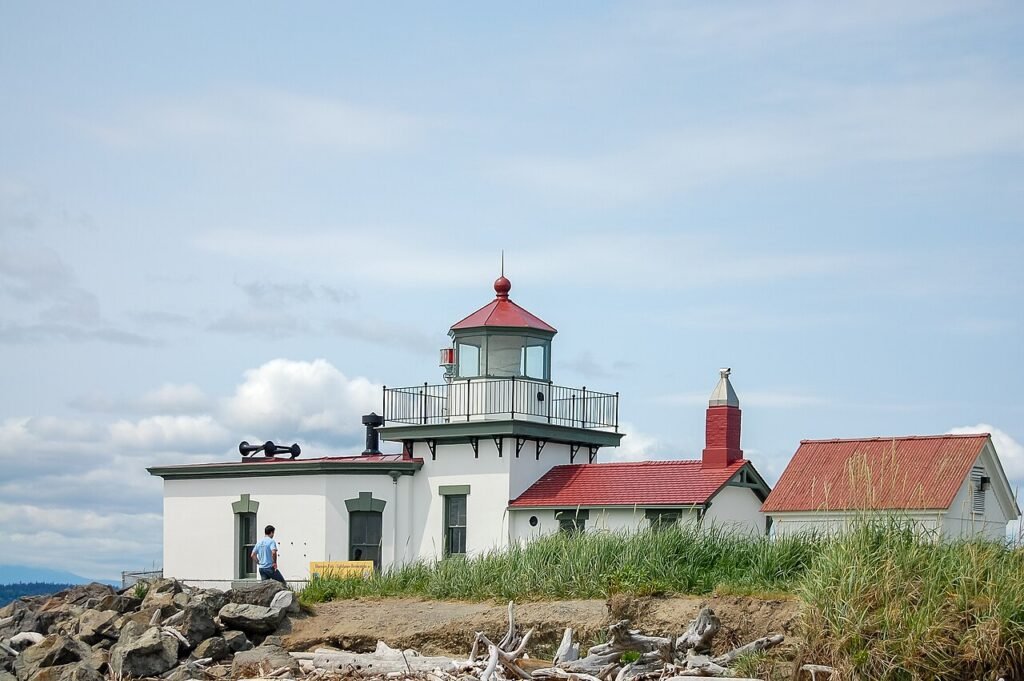 Image credit: West Point Light in Discovery Park, Seattle, Washington.
Forest Ecosystems and Native Plants
Seattle’s maritime climate, mild, wet winters and dry summers with roughly 38 inches of annual rainfall, shapes the park’s forest character. The upland trees are dominated by Douglas fir (Pseudotsuga menziesii), red alder (Alnus rubra), and big-leaf maple (Acer macrophyllum). Much of this forest is second-growth, meaning it regrew after the original trees were logged in the early 20th century.
Invasive species, particularly English ivy and Himalayan blackberry, have displaced native plants across large sections of the park. Seattle Parks and Recreation oversees active restoration work to reintroduce native species including sword fern, salal, and red-flowering currant. The open meadows, formerly military parade grounds, bloom with native camas (Camassia quamash) in spring, a plant of deep cultural significance to the Coast Salish peoples who inhabited this land for thousands of years before European settlement.
Wildlife and Birding
The National Audubon Society designates Discovery Park as an Important Bird Area (IBA), a formal recognition that the park supports bird populations of significant conservation value. The park sits within the Pacific Flyway, the major migratory corridor running along the West Coast, making it a reliable stop for dozens of species traveling between Alaska and Central America each year.
The tidal flats at West Point draw shorebirds like dunlin and western sandpiper during spring and fall migration. The open meadows provide some of the best songbird habitat in King County. Early morning in April and October, when Seattle temperatures typically sit between 45°F and 58°F, represents peak birding season at the park.
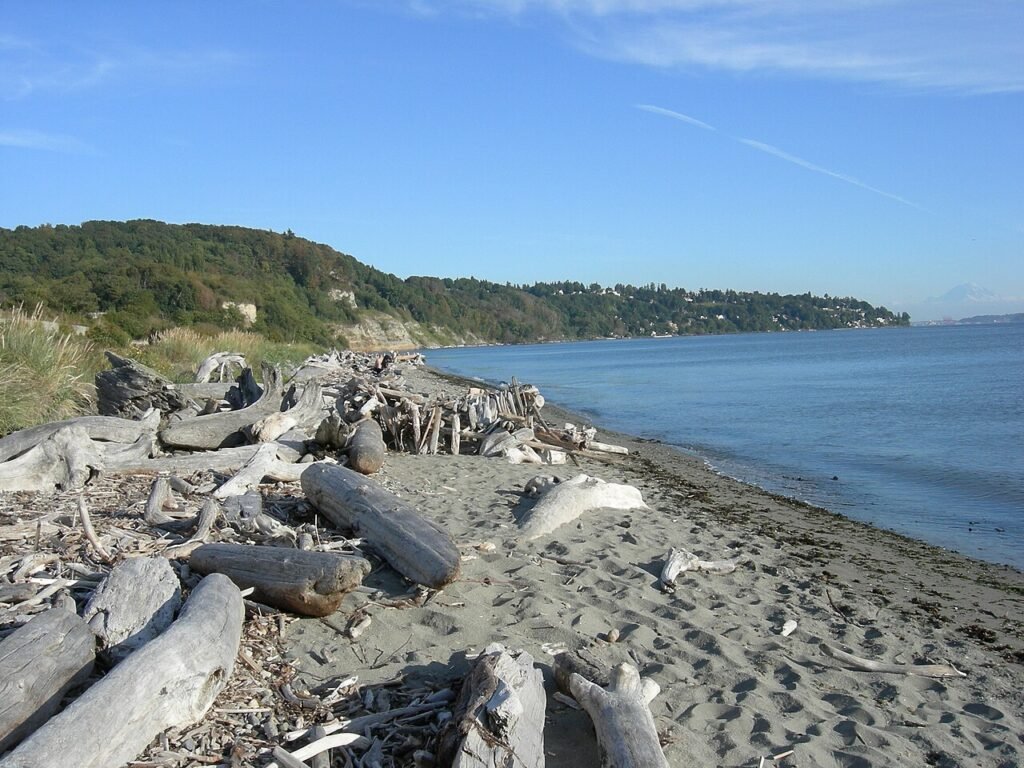 Image credit: Joe Mabel, CC BY-SA 3.0, via Wikimedia Commons

The Coastal Zone and Tidal Beach
The lower beach at West Point is one of Seattle’s few remaining stretches of natural urban shoreline. Its intertidal zone, the area alternately covered and exposed by tidal cycles, supports native Olympia oysters, marine invertebrates, and forage fish that feed the broader food web. NOAA’s tides database provides accurate Puget Sound tidal forecasts for visitors planning beach access around low tide.
Beach trails become muddy and slick from November through March. Seattle’s wet season averages over 5 inches of rain monthly during this period. Waterproof footwear and layered clothing are practical necessities for winter visits, but the park remains fully accessible, and the winter shoreline carries a dramatically different atmosphere than summer.
Why Natural Environments Matter for Wellbeing
Environmental psychologists Rachel and Stephen Kaplan developed Attention Restoration Theory to explain why time in nature reliably reduces mental fatigue. Their research found that natural settings engage what they called “soft fascination”, a low-demand form of attention that allows the directed focus required by work, study, and decision-making to recover. Discovery Park’s combination of forest, open water views, and coastal exposure makes it unusually well-suited to this kind of recovery.
A 2019 study published in Frontiers in Psychology found that just 20 minutes in a natural setting significantly reduced cortisol, a primary physiological marker of stress. Regular time in green spaces is also associated with improved mood, lower blood pressure, and stronger immune function. For Seattle residents experiencing burnout, anxiety, or accumulated daily pressure, parks like Discovery offer one of the most accessible and evidence-supported forms of relief available.
Seattle’s climate makes year-round park access realistic for most residents. The city averages only 28 days below freezing annually, according to National Weather Service Seattle data, meaning Discovery Park remains walkable and safe throughout winter, even when other parts of the country are locked in ice and snow. The park asks nothing of visitors except the willingness to show up.